
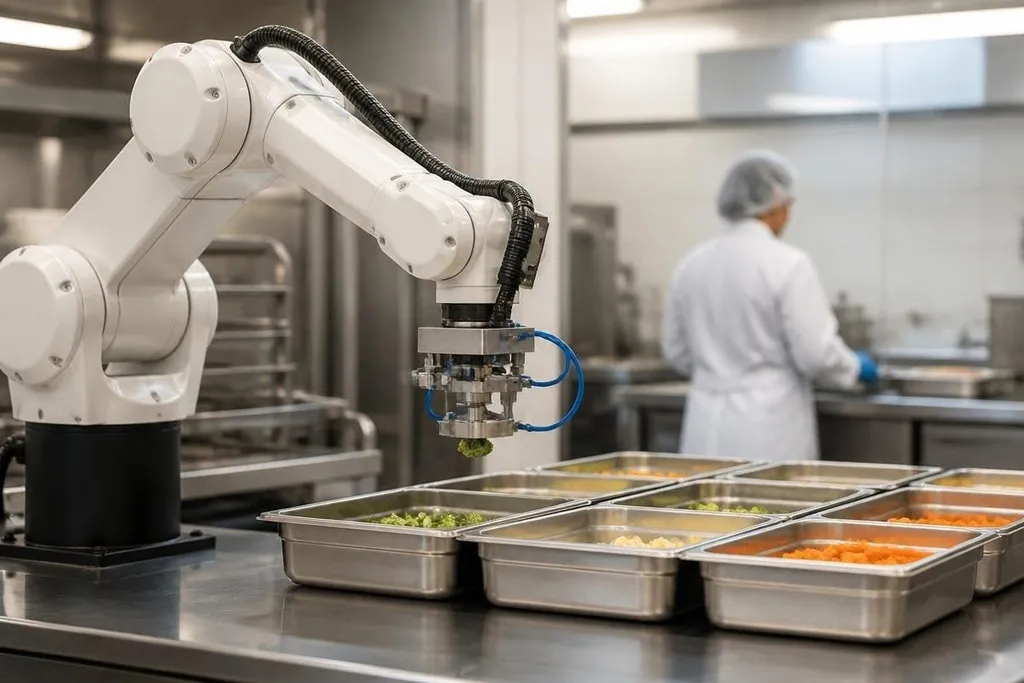
A kitchen robot does not need to cook an entire meal to change food production. It only needs to repeat one task safely, at the same speed, for long enough to pay for its space and service.
Quick read:
- Repetition is the first target
- Food safety matters as much as motion
- Human staff will still handle exceptions
Where automation fits first
Automated food preparation works best when the work stays in one place and follows a known pattern. A system can portion ingredients, move trays, dispense sauces, load ovens, or place finished items into containers without making every decision from scratch.
That narrow scope matters because food is difficult to handle. A tomato changes shape when it is cut. Dough can stretch, stick, or tear. A cooked item may be hot, soft, wet, or easy to damage. The robot needs sensors, suitable tools, and a process that limits those changes.
Restaurants and food factories will therefore start with stations where the task repeats many times. A machine that fills the same container hundreds of times has a clearer job than a general-purpose robot asked to prepare any dish from any ingredient.
The machine has to deal with food, not parts
Factory robots often move rigid objects with fixed shapes. Food preparation adds touch, temperature, moisture, and hygiene. A gripper that works on a box may crush bread or fail to hold a slippery piece of fruit.
The end effector, which is the tool at the end of a robot arm, must match the food. Suction can move flat items, while soft fingers may handle products that deform. A dispenser can control sauce or batter, but it also needs cleaning and a way to prevent buildup.
Sensors help the system check position, weight, temperature, or appearance. They don't remove the need for process design.
The food still has to arrive in a form the robot can pick up, and the work area has to keep people clear of moving parts and hot equipment.
A food robot’s claimed task needs more than a plated dish at the end of a demo. Food-preparation robotics reporting can tie the machine’s tool, timing, temperature checks, and human help to a named test. Those details lead into the next test: food safety.
Food safety sets the pace
A food robot must fit into cleaning routines, inspection work, and local food rules. A machine that saves labor but takes too long to wash may create a new delay between production runs.
Designers also need to control contact between raw and cooked ingredients. Separate tools, clear cleaning steps, and records of temperature or handling can matter as much as arm speed. The right question is not only whether the robot can perform a task, but whether staff can check that task every day.
Maintenance has a similar effect. A kitchen cannot treat a failed motor or blocked nozzle like a minor software fault. The operator needs access to the machine, replacement parts, and a manual process that keeps orders moving during repairs.
People will handle the awkward work
Food preparation changes when ingredients, orders, or equipment fall outside the normal range. A worker may need to remove a damaged item, refill a supply, clear a jam, or inspect food that a camera cannot classify with enough confidence.
That makes automated food preparation a shared process rather than a fully empty kitchen. Staff may load ingredients, check output, clean tools, and step in when the system sends an alert. The job changes, but the work does not disappear.
I'd skip any system sold as a replacement for an entire kitchen before the maker shows long-running results in the exact setting where it will operate. A short demonstration can show motion; it cannot show cleaning time, failure recovery, or the cost of a month of service.
A buying checklist for food operators
Before choosing an automated food-preparation system, check these points:
- Name one task: write down the exact action the robot must repeat and the food it will handle.
- Measure the handoff: record how ingredients arrive, where finished items go, and what a worker must do between steps.
- Ask about cleaning: get the washing method, daily time, removable parts, and approved materials in writing.
- Plan for failure: define the manual process for jams, sensor errors, empty supplies, and power loss.
- Price the whole setup: include tools, guarding, integration, service, training, and downtime alongside the machine price.
The next useful proof will come from food sites that report output, cleaning time, stoppages, and staff work over full shifts. Until those figures are available for a specific task, the safest bet is a robot at one station, with a person close enough to fix what the robot cannot.